Materials & Everyday Use
Why Linen Totes Age Well: A Look at Libeco’s Material and Craft
A good bag does not remain unchanged. It softens at the handles, gathers the faint record of ordinary errands, and becomes less an object than a familiar instrument. Linen, with its sturdy fibers and unstudied texture, is especially suited to this kind of gradual life.
Published October 23, 2026
A tote bag is often acquired in a moment of optimism. It promises to make the grocery run more orderly, the trip to the library more dignified, the accumulation of small necessities less visible. Then it is put to work. It carries a book whose corners are sharper than expected, a bottle that leaks, a sweater brought along against a weather forecast that proved correct. The bag is tugged from a hook, folded into a suitcase, set down on a station floor. Its life is made from these minor encounters.
Linen is an interesting material for such a life because it does not depend on looking untouched. Its surface is textured rather than glassy; its creases are part of its character, not necessarily evidence of neglect. Made from flax fibers, linen has a long history in household textiles and clothing, where its strength, breathability, and capacity to become softer with use have made it a practical choice. In a bag, these qualities meet a familiar test: whether a material can withstand repetition without becoming tiresome to handle or difficult to maintain.
Libeco’s linen bags offer a useful example of how material and construction shape everyday performance. The details matter: the weight of the fabric, the weave, the way handles and seams are finished, and the treatment applied to the cloth. None alone guarantees a long life. Together, they help determine whether a tote feels insubstantial, stiff, reassuringly substantial, or suited to a particular kind of use.
The fiber behind the familiar texture
Flax is a plant, and linen is the textile made from its fibers. That distinction is worth keeping in mind because the name of a fiber does not, by itself, tell us everything about the finished fabric. Cultivation, fiber preparation, yarn construction, weaving, dyeing, and finishing all affect what a piece of linen feels like and how it behaves. “Linen” is not a single specification, any more than “cotton” is.
At the fiber level, linen is known for tensile strength and a distinctive, slightly irregular surface. Individual flax fibers are relatively long, and their natural stiffness contributes to a fabric that can feel crisp when new. With handling and laundering, that crispness may ease. The cloth can become more supple while retaining a visible grain. This change is one reason an older linen tote can seem more comfortable than a new one: it has accommodated itself to the hand, the shoulder, and the habitual way it is packed.
There is a difference between softening and wearing out. Softness can arise through ordinary use; thinning, broken yarns, and holes signal damage. The first is often a welcome transformation. The second asks for attention. A cloth that has softened but remains structurally sound may have many useful years ahead. Judging a bag only by whether it still looks new misses the point of a material designed to be handled.
Linen’s texture also helps explain why small marks do not always dominate its appearance. A smooth, uniform surface can make every crease or scuff appear conspicuous. The natural variation in linen gives the eye more to read: yarns, slubs, and changes in light across the weave. This is not a promise that stains disappear or that wear cannot show. It is simply one reason the material’s ordinary irregularities can feel compatible with use rather than at odds with it.
Weight is a clue, not a verdict
Fabric weight is one of the first useful details to consider when choosing a tote. A heavier cloth can feel more substantial and may be better suited to repeated carrying, but weight alone is not a durability certificate. The weave, yarn quality, seams, handle attachment, and intended load all matter. A thick fabric with weak stitching can fail at the stress point; a lighter cloth, well constructed and used for appropriate loads, may serve reliably for years.
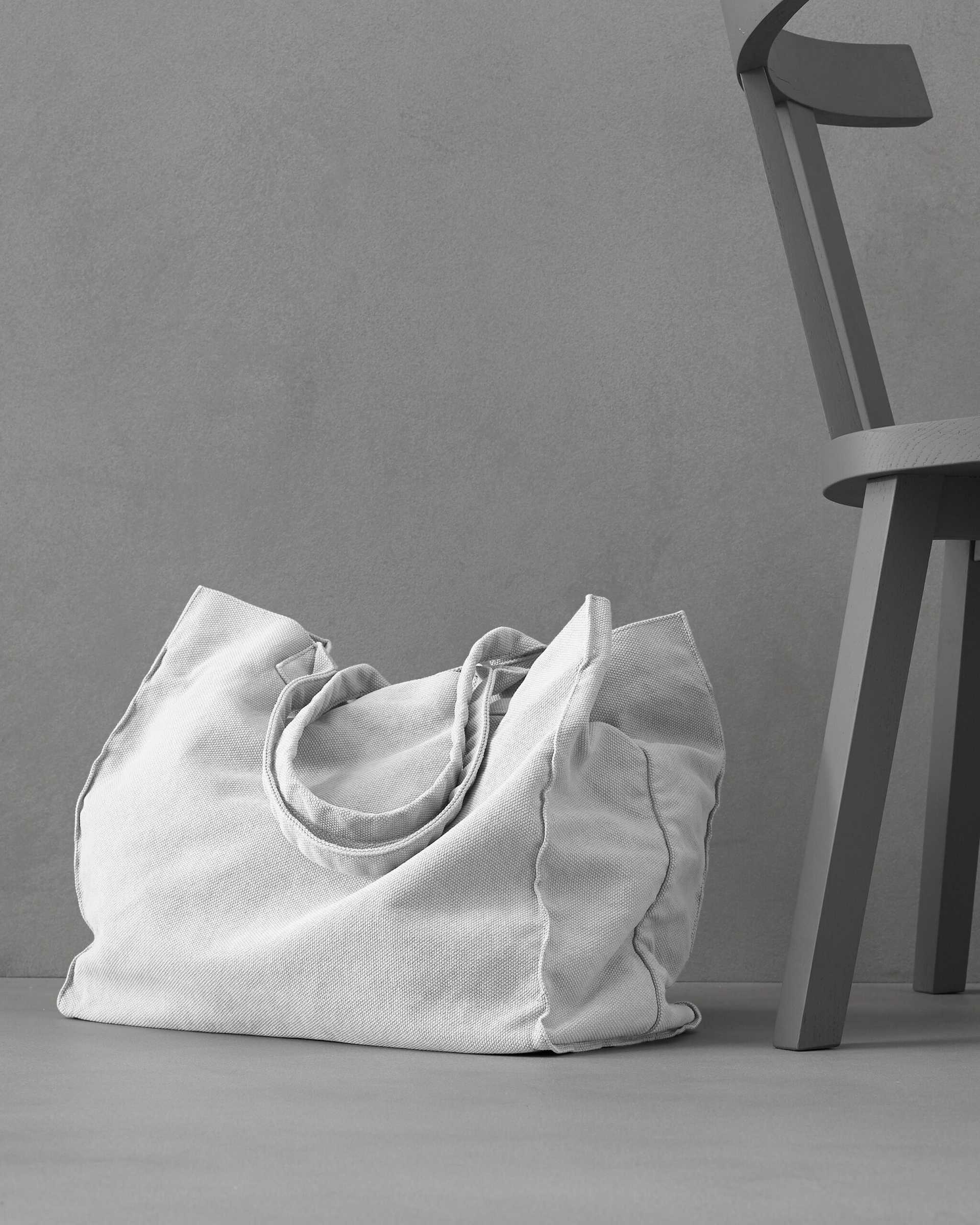
Libeco’s Atlas Shouldersac provides a concrete example of the information a product description can offer. It is described as having a body made from 100% linen, with a stonewashed finish, stripe detailing, and pure linen trim on the handles. Its listed fabric weight is 15 ounces per square yard, or 520 grams per square metre. Those figures do not predict an exact lifespan, but they help establish that this is not an airy, gauzelike cloth. The bag is designed around a relatively substantial linen fabric and a considered set of details.
Weight is most useful when considered alongside the bag’s purpose. A tote for a few light essentials does not need the same structure as one expected to carry books, groceries, or travel items. The heavier the usual load, the more attention should be paid to handle width, seam reinforcement, the way the handles attach to the body, and whether the bag’s shape distributes weight comfortably. In practical terms, a sound fabric cannot compensate indefinitely for overloading.
There is also a distinction between weight and stiffness. A dense fabric can still feel pliable; a lighter one can feel crisp because of its weave or finish. A bag that holds its shape may be easier to pack neatly, while a softer tote folds down more readily when empty. Neither quality is automatically better. The right balance depends on how a person actually carries a bag, rather than the imaginary life of effortless errands that accompanies many purchases.
Weave, seams, and the places that bear the load
Durability is often discussed as if it lived entirely in the cloth. In a bag, it is distributed across the object. The body bears friction and abrasion; the base takes the weight of whatever is packed; the handles carry the repeated pull of lifting; seams join parts that move differently under tension. A thoughtful construction recognizes that these areas do not experience use in equal measure.
When inspecting any linen tote, look at the joins. Are the handles securely attached? Are the seams even, without obvious gaps or loose threads? Does the base seem appropriate for the bag’s intended contents? These questions are not a guarantee against future damage, but they can help distinguish a bag made for regular use from one whose appearance has been prioritized over its working parts. A well-made tote is not simply a rectangle of strong cloth; it is a small system of stress and support.
Weave affects the way a fabric responds to friction and tension. A close, even weave can help create a stable surface, while looser constructions may be more flexible but less suited to sharp, heavy, or abrasive contents. No weave is invulnerable. Keys, rough packaging, metal hardware, and repeated contact with a rough wall or floor can wear the same area over time. A liner, where present, can improve organization and reduce some contact with the outer cloth, but it too adds material and care considerations.
Finishing plays its part. Stonewashing, as noted for the Atlas Shouldersac, gives fabric a softened, worn-in character. It changes the hand and appearance of the cloth, making it feel less formal than a crisp, untreated surface. Finishes can influence how a bag feels at the outset, but they should not be confused with an assurance that it will resist every stain, crease, or abrasion. The best expectation is a material that can be used, cleaned according to its care instructions, and allowed to develop naturally.
Care that keeps a bag in circulation
A linen tote’s long life depends as much on habits as on its original construction. Care need not be elaborate. Empty the bag after use, shake out crumbs and grit, and give it time to air before putting it away. Dirt trapped in the weave can become abrasive as the cloth is folded or rubbed. A bag that has been damp should be dried thoroughly before storage, since prolonged moisture can encourage unpleasant odors and weaken the pleasantness of using it.
For cleaning, the care label should take precedence over general advice. Linen can often be washed, but the right method depends on the fabric, dye, trim, lining, and construction. If the label permits machine washing, a gentle cycle and mild detergent are sensible starting points. Avoid crowding the machine with items likely to snag or transfer color. For a small stain, spot-cleaning may be less disruptive than washing the entire bag, though testing a discreet area first is prudent, especially on a colored or finished fabric.
Drying deserves particular care. Excessive heat can cause shrinkage or affect the shape of a finished item. Air-drying is often a conservative choice when permitted by the instructions: reshape the bag while it is damp, smooth seams and handles, and dry it away from harsh direct heat. If ironing is appropriate, follow the label and use a temperature suited to linen. Some people prefer the relaxed rumple of linen; others prefer a smoother surface. This is a matter of taste, not a measure of whether the bag is being cared for correctly.
Storage is simple but consequential. A tote kept folded under a heavy stack may acquire sharp creases; one hung by a narrow handle for months may experience unnecessary strain at the attachment point. When possible, store it empty, clean, and dry, either loosely folded or on a broad hook. If the bag has a particular shape, a little clean tissue or soft cloth inside can help it retain that form without forcing the seams.
- Brush away dry dirt and empty pockets before it settles into the fabric.
- Check the care label before washing, ironing, or using a stain treatment.
- Let damp linen dry fully before storage.
- Keep sharp, heavy, or leaking items contained so they do not abrade or stain the bag.
- Inspect handles and seams occasionally; small repairs are easier before a tear spreads.
Repair is part of the material story
A tote does not become disposable because a seam begins to loosen. If a handle attachment starts to pull, or a small split appears along a seam, prompt repair can preserve the rest of the bag. A simple stitch may be enough for minor damage; heavier repairs may benefit from a tailor or repair service familiar with textiles and bag construction. The important thing is to address stress before it travels farther through the cloth.
Repair also asks the owner to notice how the bag is being used. A recurring tear at the same point may suggest that the load is too heavy, that an object inside is catching on the fabric, or that the bag is repeatedly lifted by one handle when full. Changing that habit can be as valuable as repairing the damage. Care is not a ritual performed after something goes wrong; it is attention to the ordinary forces that make it go wrong.
When a bag can no longer serve its original purpose, there may still be another use for it. A softened tote can become a laundry carrier, a storage bag, or a container for light items at home. Reuse is not a substitute for responsible production, and it does not erase the resources used to make an object. It does, however, extend the period during which those resources provide practical value. In that modest sense, continuing to use a bag is a meaningful part of a more circular approach to belongings.
What a “sustainable” bag can—and cannot—promise
Linen is often discussed in sustainability conversations because it is a plant-based fiber and because a durable object, used for a long time, can reduce the need to replace it frequently. But a fiber name does not tell the whole environmental story. Growing and processing flax, producing yarn, weaving and finishing fabric, transporting the finished bag, and caring for it all contribute to its broader impact. The conditions of production and the bag’s actual service life matter as well.
It is therefore sensible to be cautious about sweeping claims. “Natural” does not automatically mean impact-free, and “durable” is not a useful advantage if a bag is rarely used. A responsible assessment considers both material and behavior: how the item is made, how often it is carried, whether it is maintained, and whether it can be repaired or passed along when its first owner is finished with it.
A well-used linen tote may offer a quiet alternative to a cycle of frequent replacement. It does not need to be treated as an heirloom, or praised as virtuous for existing. It needs to be useful enough to reach for repeatedly, sturdy enough to withstand ordinary demands, and manageable enough to care for. These are unglamorous standards. They are also the standards that determine whether an accessory remains in circulation.
Aging as evidence of use
There is a particular satisfaction in an object that does not insist on staying pristine. A linen tote may crease where it is folded, soften where it is grasped, and acquire slight changes in tone with time. These signs are not all desirable: a stain can be frustrating, a frayed seam needs attention, and a torn handle is a practical problem. But a material’s capacity to age without losing its usefulness is different from a promise that it will never show wear.
The distinction helps explain linen’s appeal. It has strength without the polished impersonality of some synthetic surfaces, and a texture that seems to accept the small disorder of daily life. A stonewashed finish, a substantial fabric weight, and well-joined handles can give a bag an immediately comfortable feel, while careful use and timely repairs extend its working life. The object changes, but change is not the same as failure.
In the end, the longevity of a linen bag is neither a property of the fiber alone nor a matter of reverent maintenance. It comes from the meeting of material, construction, purpose, and habit. Choose a tote suited to the loads it will carry. Pay attention to its seams. Wash it as instructed, let it dry properly, and repair what can reasonably be repaired. Then allow the cloth to become what use makes of it: not new, exactly, but familiar—and still doing its job.